It's Not the Thunder: The Hidden Anxiety Triggers Most Dog Owners Never See Coming
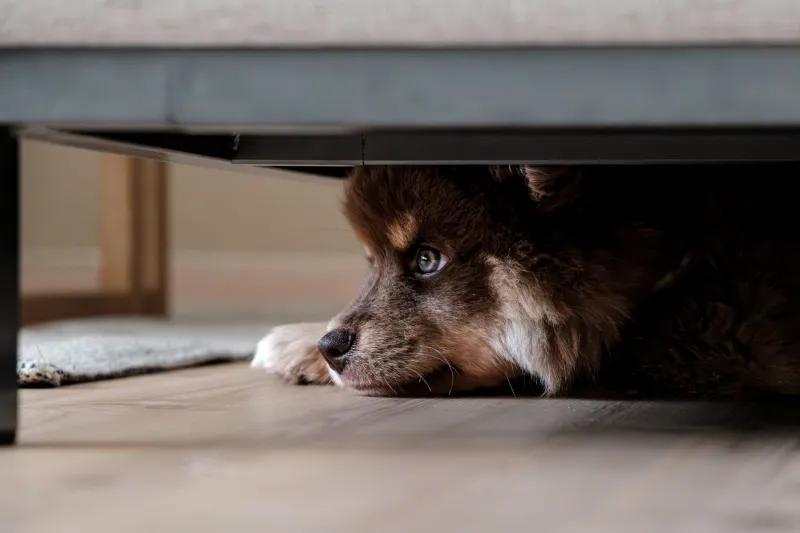
Every dog owner knows the drill. July 4th rolls around, the sky lights up, and suddenly your otherwise confident Lab is wedged behind the toilet, shaking like a leaf. Thunderstorms get the same bad rap. And sure, loud, sudden noises are absolutely a legitimate anxiety trigger for a lot of dogs — nobody's disputing that.
But here's the thing: plenty of dogs struggle with anxiety on perfectly quiet, sunny afternoons. No booms. No flashes. Just a regular Tuesday, and yet your dog is panting, pacing, or refusing to eat. If that sounds familiar, you're not imagining it — and you're definitely not alone.
The truth is, canine anxiety is a lot more layered than most people realize. And when we only look for the obvious triggers, we end up treating the surface while the real problem keeps simmering underneath.
Your Dog Might Be Feeling the Storm Before It Arrives
This one genuinely surprised me when I first heard it from a veterinary behaviorist. Dogs can detect changes in barometric pressure — the drop that happens before a storm rolls in — long before you hear a single rumble. So if your dog starts acting weird on a gray afternoon when it's still dead quiet outside, they're not being dramatic. They're picking up on something real.
Some dogs also respond to the static electricity that builds in the air before a storm. There's actually research suggesting that certain anxious dogs seek out grounded surfaces — like bathtubs or basement floors — because it reduces the static sensation on their fur. It's a small detail, but it reframes the whole picture. The anxiety isn't always about the sound. Sometimes it starts hours before the first crack of thunder.
If your dog seems to fall apart on stormy days but you can't figure out why they're already anxious before anything loud has happened, barometric sensitivity might be the missing piece.
Routine Disruptions: The Invisible Earthquake
Dogs are creatures of habit in a way that's hard to overstate. Their internal clocks are remarkably precise, and when something throws off the rhythm of their day, it can register as a genuine threat.
Think about what happens when you go back to work after a long vacation. Or when daylight saving time shifts your morning walk by an hour. Or when a family member moves out. To us, these are life adjustments. To your dog, the entire predictable structure of their world just tilted sideways.
I noticed this with my own dog after I started working from home full-time. She had been fine with me leaving for the office every day — totally adjusted, totally chill. But once I was home all day, every day, she recalibrated her entire sense of normal around my constant presence. The first time I went back into an office for a full day, she was a wreck. Same dog. Same house. Completely different anxiety response.
Routine disruptions are sneaky because they don't look like a trigger. There's no loud noise, no stranger at the door. It's just... things feel different. And dogs feel that.
Visual Changes That Fly Under the Radar
Here's one most people never consider: dogs can get genuinely unsettled by visual changes in their environment. New furniture in an unexpected spot. A pile of moving boxes stacked in the hallway. A hat hanging on a hook where nothing used to be. Halloween decorations suddenly appearing on the neighbor's porch.
This sounds almost silly until you think about how dogs process their world. They rely heavily on spatial memory and visual consistency. When something in their familiar environment looks wrong — even something small — it can register as a potential threat until they've had time to investigate and confirm it's safe.
If your dog has been acting skittish lately and you can't figure out why, do a slow walk-through of your home and yard from about their eye level. You might be surprised what you notice.
The Stress You're Carrying Into the Room
This is the one that tends to make people uncomfortable, because it puts some responsibility back on us. But it's too important to skip.
Dogs are extraordinarily attuned to human emotional states. They read our body language, our vocal tone, our scent — yes, our scent, because stress hormones are detectable. When you're anxious, grieving, or going through a rough patch, your dog knows. And for some dogs, especially those who are already prone to anxiety, absorbing your emotional state can tip them over the edge.
This doesn't mean you need to perform happiness for your dog's benefit or feel guilty every time you have a hard day. It just means the connection is real and worth acknowledging. If your dog's anxiety seems to spike during periods when you're particularly stressed — a demanding work project, a difficult family situation, a health scare — that correlation probably isn't a coincidence.
Some owners find that practicing their own calming strategies (even simple things like slower breathing or deliberate, calm movement) actually has a measurable effect on their dog's demeanor. It's a two-way street.
So What Do You Actually Do With This?
The first step is becoming a better observer. Instead of waiting for the obvious triggers, start keeping a simple log when your dog shows anxious behavior. Note the time, the weather, what happened earlier in the day, how you were feeling, and anything that changed in the environment recently. Patterns will start to emerge.
Once you've identified the likely culprits, you can start addressing them at the source rather than just managing the meltdown after the fact. That might look like:
- Maintaining consistent routines even when your own schedule shifts, especially around feeding and exercise times
- Gradual desensitization to environmental changes — introducing new objects slowly and letting your dog investigate at their own pace
- Talking to your vet about whether your dog's anxiety has a physiological component, especially if barometric sensitivity seems to be a factor
- Working with a certified professional dog trainer or veterinary behaviorist if the anxiety is significantly affecting your dog's quality of life
And please — resist the urge to just wait it out or assume your dog will "get over it." Anxiety that goes unaddressed tends to compound over time, not fade on its own.
The Bigger Picture
Living with an anxious dog is genuinely hard. It's emotionally draining, it can feel isolating, and it's easy to fall into the trap of thinking you've somehow failed them. You haven't.
But the dogs who get the most relief are almost always the ones whose owners took the time to look past the obvious and ask harder questions. What does calm actually look like for my dog? What specifically precedes the anxiety? What am I bringing into the room?
The answers aren't always comfortable. But they're almost always worth finding.