Those Big Eyes Aren't Just Cute — Here's What Your Dog's Stare Is Actually Saying
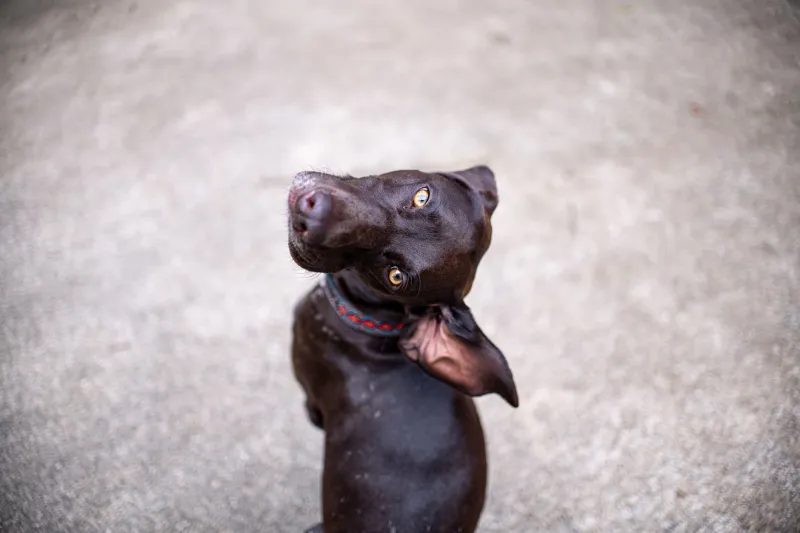
You're sitting on the couch, minding your own business, maybe watching TV or scrolling your phone. And then you feel it — that presence. You look down and there's your dog, absolutely locked onto your face like you're the most fascinating thing on the planet. Or like you're holding a cheeseburger behind your back.
So which is it? Love? Manipulation? Something in between?
The answer, as with most things in dog behavior, is more layered than you'd expect. That stare your dog gives you has roots in biology, training history, emotional state, and yes — sometimes a very calculated attempt to score a snack.
The Oxytocin Connection (Yes, It's a Whole Thing)
Here's where it gets genuinely cool. Research out of Japan — a now-famous study published in Science — found that when dogs and their owners make eye contact, both species experience a spike in oxytocin. That's the same bonding hormone that surges between human parents and their babies. The mutual gaze literally creates a feedback loop of attachment.
In other words, when your dog stares into your eyes and you stare back, you're both getting a little hit of that warm, fuzzy bonding feeling. It's not nothing. It's biology doing something remarkable — especially when you consider that this kind of cross-species gaze bonding doesn't happen with wolves, even hand-raised ones. Dogs evolved this ability specifically through their relationship with humans.
So yes, sometimes your dog is genuinely expressing affection. That slow, soft-eyed look your dog gives you when you're cuddled up together? That's real. Treasure it.
But Let's Talk About the Other Kind of Stare
Not every gaze is a Hallmark moment. Dogs are also incredibly perceptive creatures who have figured out — through years of living alongside humans — exactly which behaviors get results.
If your dog stares at you every single time you open the refrigerator, sits and locks eyes with you while you eat dinner, or positions themselves directly in your line of sight the moment you reach for the treat bag, that's not bonding. That's strategy. And honestly? Respect. It works, doesn't it?
This kind of learned, operant staring develops because we reward it — usually without meaning to. You glance at them, they look cute, you give them a bite of your sandwich. Boom. The behavior gets reinforced. Now you have a dog who has essentially trained you to respond to eye contact with food.
This isn't a problem, exactly. But it's worth recognizing so you don't confuse a well-timed manipulation with a deep emotional moment.
When Staring Signals Stress — Not Connection
Here's the part that trips a lot of dog owners up: prolonged, hard eye contact isn't always a sign of love or even scheming. In dog body language, a fixed, unblinking stare — especially when paired with a stiff body, tense jaw, or still tail — can actually be a warning sign.
Dogs use hard stares to communicate discomfort or to signal that they need space. If an unfamiliar dog locks eyes with you and holds it, that's not a bonding invitation. Same goes for your own dog in certain situations — if they're resource guarding a toy or food bowl and they fix you with an unblinking look, that's communication worth taking seriously.
Context matters enormously here. A soft gaze with relaxed muscles and a gently wagging tail reads completely differently than a rigid, unblinking stare with a frozen body. Learning to read the whole picture — not just the eyes — is one of the most useful skills you can develop as a dog owner.
The "I Need Something" Stare Is Its Own Category
There's also the very practical stare — the one that's basically your dog filing a formal request. They need to go outside. Their water bowl is empty. It's 4:58 PM and dinner is at 5:00 and they are aware of this.
Many dogs develop this kind of communicative gaze naturally, and it's actually a sign of a healthy relationship. Your dog has learned that looking at you gets your attention, and your attention leads to their needs being met. That's not manipulation in a negative sense — it's communication. It means your dog trusts you to respond.
If you want to sharpen this even further, you can use it as a foundation for training. The moment your dog makes eye contact with you, mark it (with a clicker or a verbal "yes") and reward it. This builds what trainers call "attention" or "check-in" behavior, which is genuinely useful — a dog who regularly checks in with you is a dog who's more responsive on walks, in new environments, and in distracting situations.
How to Read What You're Actually Seeing
So how do you tell the difference in the moment? Here's a simple gut-check:
Soft, warm stare + relaxed body + slow blink or look-away: Affection. Your dog is comfortable and connected with you. Feel free to stare back and enjoy the moment.
Stare + sitting up straight + perked ears + slight lean toward you: Request mode. They want something. Check the usual suspects — food, water, bathroom, walk.
Stare timed perfectly with your food or treat: Trained behavior. You've accidentally (or deliberately) taught them this works. Decide whether you want to reinforce it or redirect.
Hard, unblinking stare + stiff posture + no tail movement: Stress or a warning signal. Give them space and assess what's happening in the environment around them.
Stare while you're getting ready to leave: Could be anxiety. If this is accompanied by pacing, whining, or following you from room to room, it's worth paying attention to as a potential sign of separation stress.
You Don't Need to Overthink Every Glance
Look, this isn't about turning every shared look with your dog into a behavioral analysis. Most of the time, you'll just know — because you know your dog. You know the difference between the eyes that say "I love you" and the eyes that say "drop that chicken wing right now."
What this is really about is paying attention. Dogs communicate constantly, and their eyes are one of the richest channels they have. The more fluent you get at reading those looks — the soft ones, the hopeful ones, the worried ones — the better you'll get at meeting your dog where they actually are.
And honestly? The fact that you're even curious about what's going on in your dog's head says a lot. That kind of attentiveness is exactly what makes for a great dog owner. Your pup is lucky to have someone paying that close attention.
Even if they are absolutely, 100% just angling for your French fries.